|
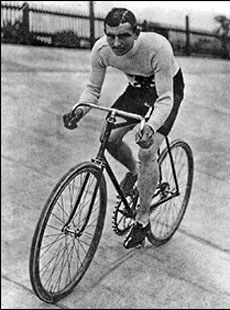 In the 1896 edition Welshman Arthur V Linton (seen left) was first to finish - but had gone off course. In the end he was given a dead-heat with Gaston Rivere of France. Arthur rode has a professional for Gladiator Cycles. However his victory was short-lived as Arthur died in July aged just 28. [Many sources claim he was 24 - but he was born in 1868. The 1872 date on his “blue plaque” refers to when he moved to that location] In the 1896 edition Welshman Arthur V Linton (seen left) was first to finish - but had gone off course. In the end he was given a dead-heat with Gaston Rivere of France. Arthur rode has a professional for Gladiator Cycles. However his victory was short-lived as Arthur died in July aged just 28. [Many sources claim he was 24 - but he was born in 1868. The 1872 date on his “blue plaque” refers to when he moved to that location]
For many years his early death, and his sporting achievements, were attributed to the “medicines” commonly used in endurance races at the time. But recently Linton’s death has been reassessed - with a researcher finding that "He actually died of typhoid and it seemed the typhoid was brought on by over-exertion." So the stories from the time may have been wrong - but time is a one-way street with no way back. Arthur Linton is now honoured with a blue plaque on Navigation House in Abercynon.
Arthur’s former trainer, James Edward “Choppy” Warburton, died in Wood Green, London the following year (Dec-1897) aged 53. But his success as a runner and trainer had not made him any money - he left only three half-pence (more). Below - Arthur Linton, Choppy Warburton, Jimmy Michael and Tom Linton.
|







 The origins of the Bordeaux to Paris cycle race are back in the 19th century. In England it was the prosperous late Victorian era and in France - La Belle Epoque. A golden age for the upper classes, as peace prevailed among the major European powers, new technologies improved lives that were unclouded by taxation - and artists adapted Renaissance and eighteenth-century styles to modern forms.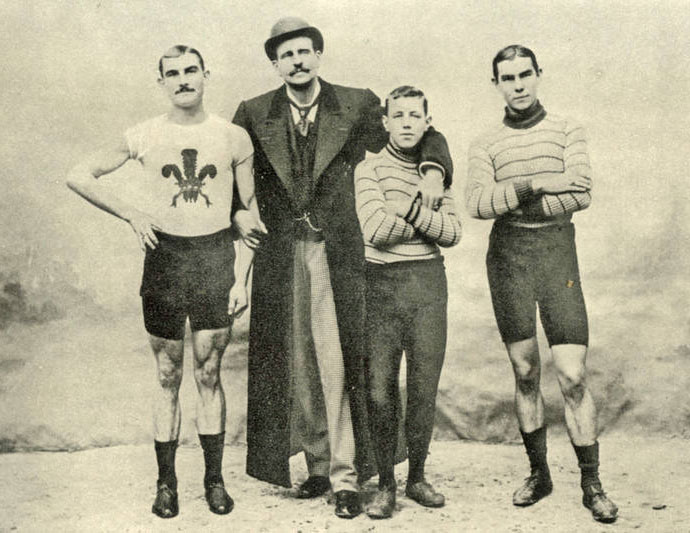
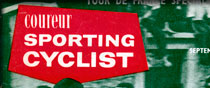
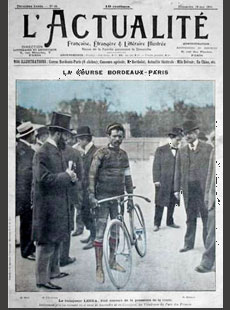 The brief period of British successes in Bordeaux-Paris was over. It was now the turn of France and Belgium to provide the headline makers - as seen here with front page coverage for 1901 winner Lucien Lesna. A pattern for pro road cycling that was to be repeated for decades to come.
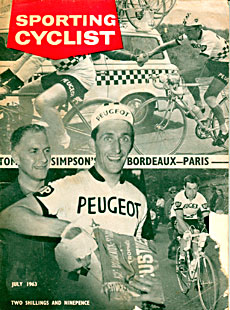 In Britain the sporting press had dropped cycling from their coverage in the early years of the sport - mainly because there was little of interest to report. The sport’s governing body the Bicycle Union, later the National Cyclists Union (NCU), did not allow professionals nor massed-start road racing. Road cycling time trials were allowed but bound-up in rules about no publicity, coded routes and disguised racing kit.
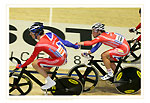
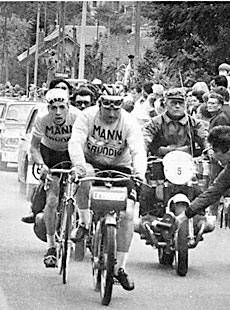 In the early days the pacers were bicycles, tandems, triplets and even quadruplets. But in 1931 motor bikes took over and this pacing became more specialised in 1938 when the Derny was introduced.